On this page
- The Click Test, Done Correctly
- The Critical Caveat: Click Count Isn't Universal Across Every Generation
- Supporting Check 1: The Helium Escape Valve
- Supporting Check 2: The Wave Dial's Physical Depth
- Supporting Check 3: Crown Position and Bracelet Taper
- Supporting Check 4: Lume Quality
- What This Combination of Checks Won't Guarantee
- Why the Diver 300M Specifically Gets Targeted
- FAQ
- Conclusion
On a current-production Omega Seamaster Diver 300M, the unidirectional bezel completes a full rotation in exactly 120 clicks, with smooth, consistent resistance and no wobble or backward play. This test isn't universal across every Seamaster ever made, though — early 1990s Seamaster Professional references, both quartz and early automatic models, used a 60-click bezel before Omega transitioned to 120 clicks on later production. Getting this reference-specific distinction right matters: applying the modern 120-click standard to an early-1990s piece would incorrectly flag a genuine vintage watch as fake.
The bezel click test is one of the more reliable physical checks available for a Seamaster Diver 300M, precisely because a rotating bezel with consistent, evenly-spaced resistance is a genuinely difficult mechanism to replicate cheaply. But it only works if you apply the right click count to the right watch — which is the part most quick authentication guides skip past.
The Click Test, Done Correctly
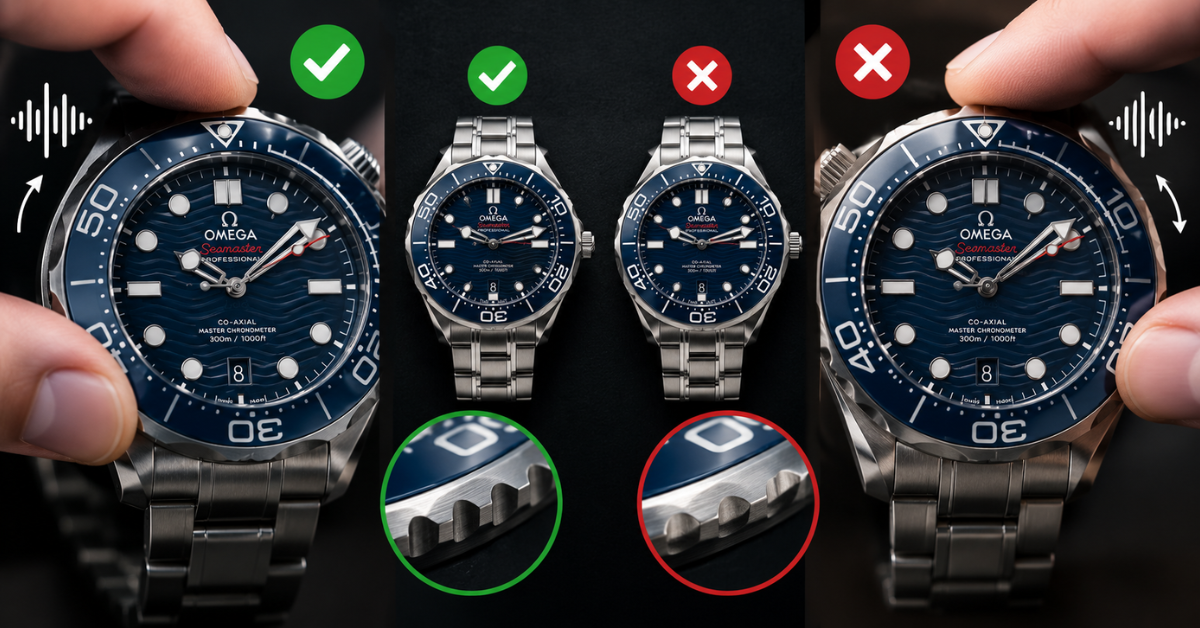
Rotate the bezel a full 360 degrees counterclockwise, counting each distinct click as you go. On a current-production Diver 300M, that full rotation should land on exactly 120 clicks, with each click feeling evenly spaced, smooth, and consistent in resistance from start to finish. There should be no backward play between clicks, no noticeable looseness, and no clicks that feel softer or harder than the rest of the rotation.
Counterfeits frequently get this wrong in one of two ways: an incorrect total click count, or a bezel action that's inconsistent — some clicks firm, others mushy, occasional skipping. Both are signs of a cheaper mechanism standing in for Omega's actual engineering.
The Critical Caveat: Click Count Isn't Universal Across Every Generation
This is worth understanding before you rely on this test with any confidence, because getting it wrong in the other direction — flagging a genuine watch as fake — is a real risk. Early 1990s Seamaster Professional references, including early quartz models and the first automatic versions produced before a certain serial range, used a 60-click bezel rather than the 120-click standard found on later production. Omega transitioned to the 120-click bezel on subsequent generations, and every current Diver 300M you'll encounter at retail or on the reputable pre-owned market today follows that 120-click standard.
In practice, this means the 120-click test applies confidently to any Diver 300M from the mid-1990s onward. If you're specifically looking at an early-production piece from right around the Seamaster's 1993 relaunch, a 60-click bezel isn't a red flag — it's period-correct. Treating every Seamaster you encounter as though it must have 120 clicks is exactly the kind of oversimplified rule that leads to false conclusions. Our Seamaster complete history covers the Diver 300M's 1993 launch and how the collection has evolved since, useful context for placing a specific piece in its correct generation before you apply this test.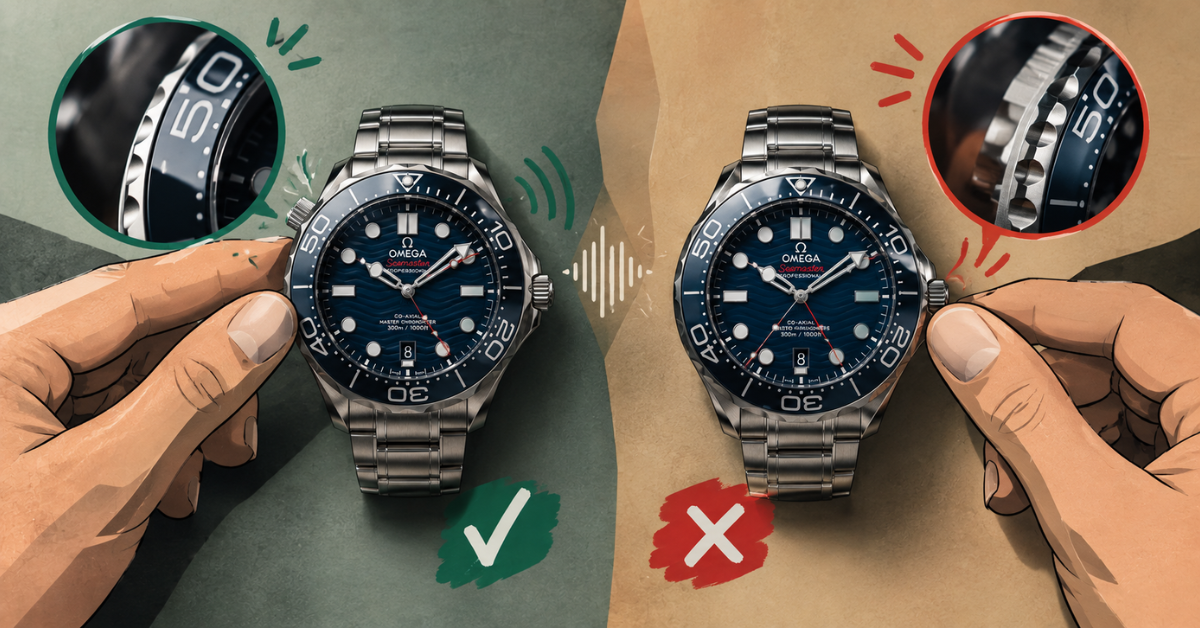
Supporting Check 1: The Helium Escape Valve
This is widely considered the single hardest Seamaster feature to counterfeit correctly, and it's worth checking right alongside the bezel. On a genuine Diver 300M, the helium escape valve sits on the left side of the case, positioned so its lower edge aligns precisely with the 10 o'clock marker on the dial. It's also a real, functional, knurled screw-down component — not a decorative addition.
Fakes get this wrong in a few consistent ways: centering the valve directly at the 10 o'clock position rather than aligning its edge there, placing it below where it should sit, or including a valve that's purely decorative — visible casting seams, incorrect knurling, and a body that won't actually unscrew are all signs of a non-functional imitation standing in for genuine engineering.
Supporting Check 2: The Wave Dial's Physical Depth
Omega's signature wave-pattern dial is laser-cut directly into the dial surface on a genuine Diver 300M, creating real, physical depth with a crisp, sculpted edge to each ripple. Tilt the watch under light and the pattern should visibly play with the light source as the angle changes, rather than sitting flat.
Counterfeits typically flatten this into a shallow surface print rather than a genuinely machined texture — under close inspection or when tilted, a printed wave pattern looks noticeably flatter and doesn't interact with light the same way. This is one of the more visually obvious tells once you know to look for it.
Supporting Check 3: Crown Position and Bracelet Taper
Two smaller but genuinely useful details worth checking together. The crown on a genuine Diver 300M aligns precisely with the 3 o'clock marker — a crown that's noticeably misaligned or doesn't screw down smoothly is a legitimate concern. The bracelet, meanwhile, should show a proper taper toward the clasp, with links that articulate smoothly and a clasp sized correctly for the case. Fakes frequently use bracelets with inconsistent link width or a clasp that feels loose or disproportionate relative to the case.
Supporting Check 4: Lume Quality
Check the lume on the hands, hour markers, and bezel pip together after a brief light charge. Genuine Omega uses high-grade Super-LumiNova, applied neatly within the boundaries of each marker and hand, charging quickly and glowing strongly and evenly across every lumed element. Lume that charges slowly, glows unevenly between different elements, or appears to spill outside a marker's edges is a common sign of a lower-grade substitute.
What This Combination of Checks Won't Guarantee
Worth being honest about the limits here, consistent with how authentication should always be approached: the highest-quality counterfeits have gotten close enough on individual details — including, in some documented cases, a correctly counted bezel — that no combination of visual and tactile checks provides absolute certainty on its own. These checks together catch the significant majority of counterfeits in circulation, particularly since replicating the helium valve and the machined wave dial correctly is genuinely expensive to do well. For any high-value purchase, professional authentication from an authorized Omega service center or an experienced independent watchmaker remains the only way to be fully certain. Our general guide to spotting a fake Omega covers additional checks — serial numbers, case finishing, movement fundamentals — that apply across Omega's wider catalog, useful alongside the Seamaster-specific checks here.
Why the Diver 300M Specifically Gets Targeted
The Diver 300M's fame — driven substantially by its role as James Bond's watch since 1995's GoldenEye — makes it one of Omega's most consistently counterfeited references. Our full Seamaster Diver 300M review covers what you're actually paying for across the current lineup, useful context for understanding exactly what a genuine example should deliver before you start checking for a fake one.
FAQ
How many clicks does a genuine Omega Seamaster Diver 300M bezel have? Current production models have exactly 120 clicks per full rotation, though early 1990s references used 60 clicks before Omega transitioned to the 120-click standard on later production.
Is a 60-click Seamaster bezel always a sign of a fake? No — early Seamaster Professional references from around the 1993 launch genuinely used 60-click bezels, so this only applies to modern production; period-correct vintage pieces shouldn't be judged against the current standard.
What's the hardest Seamaster feature for counterfeiters to replicate? The helium escape valve is widely considered the most difficult — many fakes either omit it entirely or include a non-functional decorative version with visible seams and incorrect positioning.
Can the bezel click test alone confirm a Seamaster is genuine? No — it's a strong supporting check, but should be combined with the helium valve position, wave dial depth, and lume quality checks, and professional authentication remains the only certain method for high-value purchases.
Why is the wave dial pattern a reliable authentication check? Genuine dials are laser-cut with real physical depth that interacts with light as the watch tilts, while counterfeits typically use a flat surface print that looks noticeably different under close inspection.
Conclusion
The bezel click test is genuinely useful, but only when it's applied with the right context — 120 clicks for current production, 60 for early-1990s references, and never treated as one universal number across the entire Seamaster Diver 300M lineage. Combined with the helium valve position, the wave dial's physical depth, and lume quality, it catches the overwhelming majority of counterfeits in circulation. For anything beyond a routine check, professional authentication remains the final word.
Editor-in-Chief
Editorial Team